

A capsule wardrobe after 50 usually starts with a familiar feeling: a closet packed with clothes and nothing to wear. Some pieces pinch at the waist now. Some belong to a job you left years ago. A few still have the tags on, and you’re not sure why you bought them.
Here is the short answer. A capsule wardrobe is about 30 to 40 pieces that all work together, chosen for the body and the life you have today. You can build one in 8 steps over two or three weekends. Start with how you spend your week and which colors suit you. Then sort, check fit, build outfits and test them. Shopping comes last, and you’ll need far less of it than you expect.
This plan covers every step of a capsule wardrobe for women over 50. You’ll learn how many pieces to keep, how to choose your colors without regret, and what to do with the “maybe” pile. You’ll also learn how to stop the closet from filling up again.
What a Capsule Wardrobe After 50 Looks Like
A capsule wardrobe after 50 is a small set of clothes, usually 30 to 40 pieces, in colors that all mix and match. Every top works with most of your bottoms, every layer goes over most of your tops, and every piece fits the body and schedule you have now.
How Many Pieces You Need
Most capsules land between 30 and 40 pieces for one season. That count covers tops, bottoms, dresses, layers and shoes. Underwear, sleepwear and workout clothes don’t count. A popular minimalism challenge called Project 333 uses 33 items for 3 months, which is a good target if you like a firm number.
Fewer than 30 pieces can feel repetitive if you live with four real seasons. More than 45 brings back the morning stare at a full closet. Out-of-season clothes go in storage and don’t count toward your number.
Why It Fits This Stage of Life
Bodies and routines change after 50, and a capsule wardrobe makes you dress for the changes instead of fighting them. Hormone shifts at menopause move fat storage toward the midsection, so waistbands and tops that fit at 40 may pull or gape now. Hot flashes make breathable fabrics and easy layers matter more. Retirement, a new job or an empty nest can change how many dressy pieces you need.
Fewer, better clothes also mean less waste. Textile waste in the US reached about 17 million tons in 2018, and most of it went to landfill.
If you’re still unsure whether a smaller closet suits you, our guide to deciding between a capsule and full wardrobe compares both.
Write Down How You Spend Your Week
Spend 15 minutes writing down where your hours go in a normal week. Your capsule should match the life you live, not a magazine’s idea of it, and this short list decides what share of your closet goes to casual, work and dressy clothes.
Split your week into a few groups and give each one a rough percentage:
- Home and errands: groceries, gardening, school runs with grandkids
- Work or volunteering: office days, client meetings, shifts
- Social plans: lunches, church, dinners out
- Exercise and outdoor time: walks, classes, golf
- Travel: weekends away, a yearly trip
If home and errands take 60% of your week, about 60% of your capsule should be comfortable casual pieces. Many women build around the dressy life they used to have, or the one wedding on the calendar, and end up with nothing to wear on a Tuesday.
Note which you reach for more often, dresses or pants. That habit shapes your whole capsule, and our guide to settling the dresses vs pants question helps you decide.
Choose a Color Palette Before You Clear Anything Out

Before a single sweater leaves your closet, pick the colors your capsule will use. A capsule wardrobe color palette is two neutral base colors plus one or two accent colors. Choosing it first stops you from giving away the shades that suit you best.
Women who skip this step often donate their jewel tones, then rebuild with beige that leaves their face looking tired.
Pick Cool or Warm Neutrals
Neutrals are the quiet colors that make up most of a capsule: pants, layers, shoes and bags. Cool neutrals are black, charcoal, navy and crisp white. Warm neutrals are camel, brown, olive and cream.
To test, stand by a window in daylight. Hold a navy or black top under your chin, then a camel or cream one. The color that makes your skin look rested and even is your side. Your jewelry box gives a second clue: if you always reach for silver, cool neutrals usually win, and gold points to warm.
Add One or Two Accent Colors
Accent colors are the ones you love wearing near your face, used for tops, scarves and maybe one dress. Look for the colors you already reach for, and the ones that get you compliments. Accents keep a capsule from feeling flat.
Keep it to one or two so every accent works with both of your neutrals. For prints, pick ones that include at least one of your neutrals, so they pair with the pants and layers you already own.
Sort Everything You Own Into Four Piles

Your bed is about to disappear under clothes, and that’s the point. Pull every piece out of your closet and drawers, then sort each one into four piles: keep, maybe, tailor and donate. Seeing everything at once shows you how many black tops you own and which pieces never leave the hanger.
Use these rules for each pile:
- Keep: fits now, sits in your palette, and you wore it in the last year
- Maybe: you hesitate, even for a second
- Tailor: you love it, and the fit problem is fixable, like a long hem or a loose waist
- Donate or sell: doesn’t fit, still has tags after a year, or waits for a “someday” size
Put the maybe pile in a box and write a date three months from today on the lid. If you never open the box to wear something, donate it without looking inside. You make the call later, with a calm head, so you don’t regret a rushed decision.
Watch out for pieces you keep only because they cost a lot. The money is already spent, so ask whether you’d buy the piece again today. Sentimental pieces, like your mother’s scarf or a wedding outfit, can live in a separate small box that doesn’t count toward your capsule.
Check the Fit of Every Piece You Keep

Clothes that fit well look newer than clothes that cost more. Try on every piece in your keep pile, because a waistband or shoulder seam that worked a few years ago may not sit right on your body now.
The Sit, Reach and Walk Test
Stand in front of a full-length mirror and do three moves in each piece. Sit down on a chair and check whether the waistband digs in or the buttons gap. Reach both arms forward, then up, and see whether the shoulders pull or the top rides up. Walk across the room and watch for a skirt that creeps up or pants that twist at the leg.
A piece that passes all three stays in the capsule. Check that the shoulder seams sit at the edge of your shoulders, too. A seam that sits too far in or too far out makes the whole top look borrowed.
When a Tailor Is Worth It
A tailor can fix small problems for much less than a new piece costs. Hemming pants, taking in a waist and shortening sleeves are the common jobs. Pay for alterations on pieces you love in good fabric, not on fast-fashion basics you could replace in an afternoon.
Some fit problems can’t be fixed. A jacket that’s tight across the shoulders or a top that’s too small through the bust belongs in the donate pile. If tops now cling at the middle, a change of cut often helps more than a change of size. Our styling tricks for your midsection cover wrap fronts, soft drape and other cuts that sit comfortably and still show your shape.
Build Outfit Formulas From What’s Left
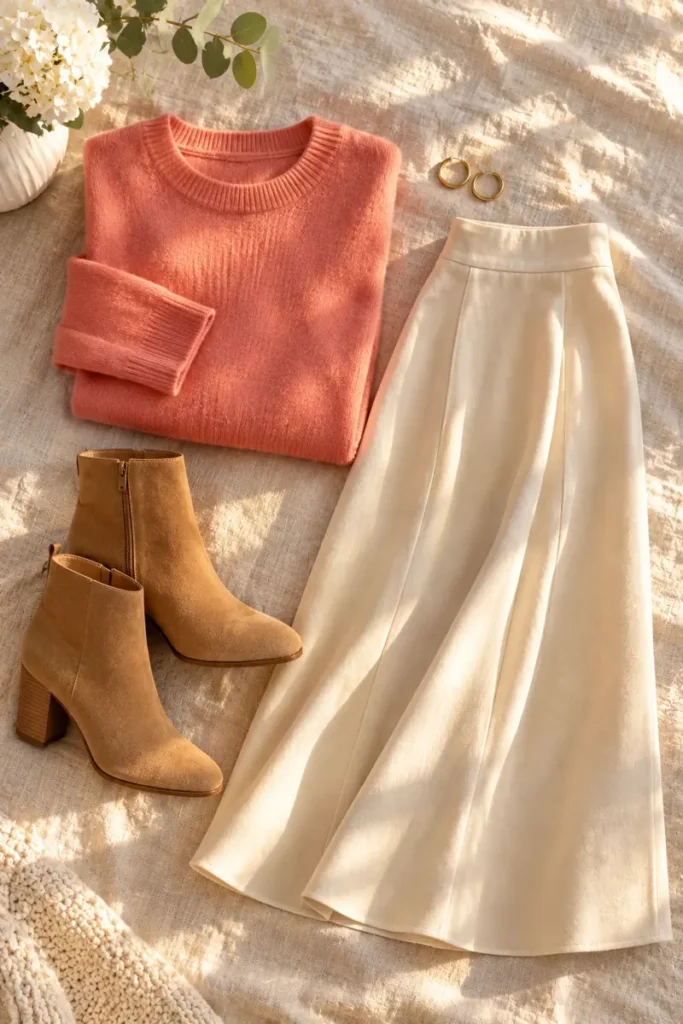
An outfit formula is a simple recipe, such as top + bottom + layer + shoe, that you repeat with different pieces. Lay out everything that passed the fit test and build as many formulas as you can. The formulas show exactly which capsule wardrobe essentials you’re missing.
A few formulas that work in most capsules:
- Tee + straight-leg pants + cardigan + loafers
- White button-down + dark-wash jeans + white sneakers
- Fine-knit sweater + midi skirt + ankle boots
- Wrap dress + blazer + flats
Write down any piece that would complete three or more outfits. If one pair of navy pants would work with six of your tops, it goes to the top of your shopping list. A piece that completes only one outfit can wait.
Pants do the most work in most capsules, so the rise matters. Our guide to choosing the right pants rise explains which one sits most comfortably on your body.
Take a quick phone photo of every outfit you build and save them all in one album called “Capsule.” On busy mornings you pick from pictures instead of hangers. After two weeks, the album also shows which pieces never appear in any photo.
Wear Only Your Capsule for Two Weeks
Hang your capsule pieces together and wear nothing else for 14 days before you buy a thing. A real trial shows you the gaps that matter, and it often proves you need fewer new pieces than your list says.
Stick a note inside your closet door. Each time you wish you had something, write it down. A wish that shows up three times is a real gap. A wish that shows up once is a want, and wants can wait.
Pay attention to the pieces you keep skipping, too. If a top sits untouched for two weeks, move it to the maybe box. Many women want to quit around day three because the outfits feel repetitive. Repeating outfits is how a capsule works, and the people around you notice far less than you think.
Shop for the Gaps One Piece at a Time
Three to five new pieces per season is plenty for most capsules, bought one at a time from your gap list. Shopping slowly gives each new piece time to prove itself before you buy the next one.
Cost per wear helps you judge a price. Divide what you pay by the number of times you’ll wear the piece. A $90 merino sweater worn 45 times costs $2 per wear. A $25 top worn 3 times costs about $8.33 per wear, so the cheaper top is the more expensive buy.
Fabric matters more after 50, because hot flashes and changing body temperature make some materials uncomfortable. Merino wool, cotton and linen blends breathe well. Ponte knit holds its shape in pants and dresses without feeling stiff. Thin polyester traps heat, so save it for pieces you wear for short stretches.
Before you buy, run these quick checks:
- Seams lie flat, with small, tight stitches
- Fabric springs back after a gentle stretch
- Light test: the fabric isn’t see-through when held up to a window
- Buttons are sewn on firmly
- Return policy gives you time to try it at home
Secondhand and consignment shops are a good option for wool coats and silk blouses at a lower price.
Keep It Working With One In, One Out
Once your capsule is built, follow the one-in, one-out rule: every time a new piece comes home, one piece leaves. The rule keeps your count steady and makes you pause at the checkout.
Swap your capsule each season. Store off-season clothes in a labeled bin under the bed or on a high shelf. When you swap, run the sit, reach and walk test again, because bodies keep changing after 50. Retire anything that’s pilled, stretched or faded.
A capsule also makes travel lighter, since every piece already works together. If you have a trip coming up, our cruise wardrobe checklist shows how a capsule packs into one suitcase.
Frequently Asked Questions
How many pieces should a capsule wardrobe have after 50?
Most women do well with 30 to 40 pieces per season, counting tops, bottoms, dresses, layers and shoes. If you want a firm number, the Project 333 approach uses 33 items for 3 months.
What colors work best in a capsule wardrobe?
Choose two neutrals from the side that suits your skin, cool (black, navy, gray) or warm (camel, olive, cream), plus one or two accent colors you love. Test them in daylight by a window, because store lighting can fool you.
How long does it take to build a capsule wardrobe?
Plan on two or three weekends to write down your week, pick colors, sort and check fit, then a two-week trial before you shop. Filling the last gaps can take a full season if you buy one piece at a time.
Can a capsule wardrobe include bright colors and prints?
Yes. Your accent colors carry the brightness, and prints work best when they include at least one of your neutrals, so they pair with pants and layers you already own.
What should I do with the clothes I take out?
Put anything you’re unsure about in a dated maybe box for three months. Give good-condition pieces to a charity shop or sell them through consignment. Take worn-out items to a textile recycling drop-off instead of the trash.
Is a capsule wardrobe boring?
A capsule feels flat only when the colors don’t suit you or every piece is beige. Accent colors, a few prints, scarves and jewelry keep it lively, and most women find fewer choices make mornings calmer.
Your Closet, Simplified
You now have a clear plan for a capsule wardrobe after 50, from the first look at your week to the last piece you’ll buy. You know how many pieces to aim for, which colors to keep, and how to let go without regret. This weekend, write down your week and hold two neutrals up to a window. That one hour sets up every step after it.