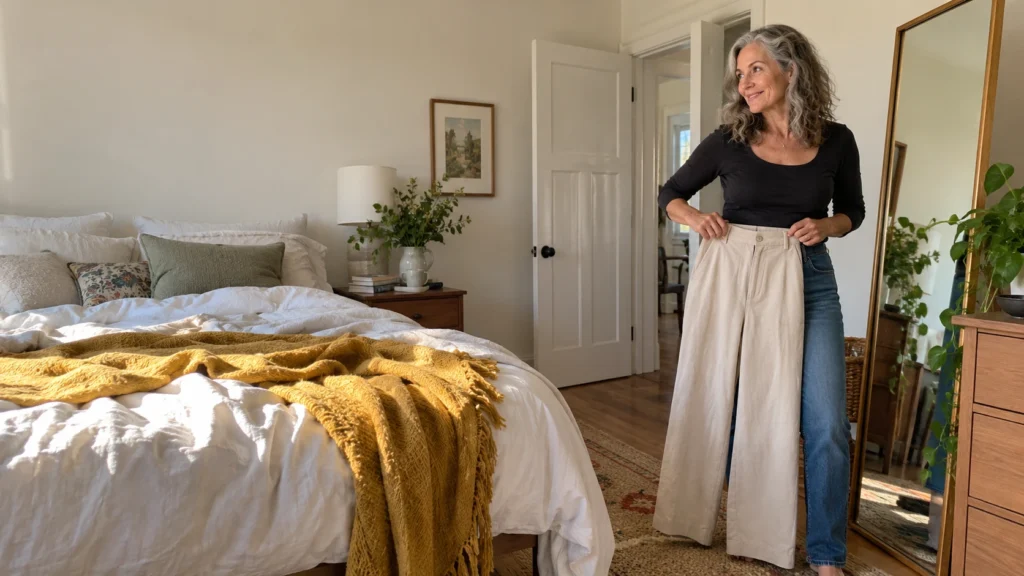
You pull on a new pair of “high rise” pants, and the waistband lands near your hip bone. Or it sits right at your waist until you sit down, then digs in. If you have ever spent a whole day tugging your pants back up, you are in good company. Choosing between high waist vs mid rise pants over 50 comes down to where the waistband lands on you, not what the tag says.
Here is the short answer. High rise tends to work if you tuck in your tops or have a long torso. Mid rise tends to work if you wear your tops out or are short-waisted. Plenty of women wear both.
Your body may have changed, too. Many women notice their waist shifting in their 50s, because menopause changes where the body stores weight. That is normal. It is a fit question, not a problem to fix.
This guide helps you find your own rise number in inches, so you can shop by a number that matches your body. You need a soft tape measure, a mirror and about 30 to 45 minutes at home, plus one try-on trip. None of it is hard, but it does take a little patience.
Know What Rise Measures Before You Shop
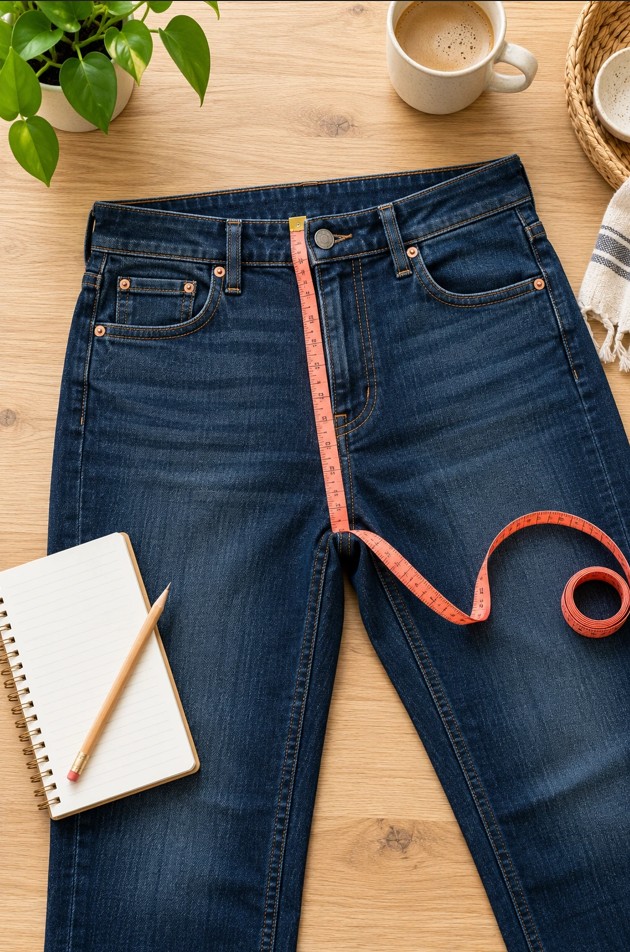
Rise is the distance from the crotch seam (where the leg seams meet) to the top of the waistband. That one number decides where your pants sit on your body.
Most size guides list the front rise. The back rise is always longer, so the pants cover your seat when you sit or bend.
Here are rough ranges:
- Mid rise: about 8.5 to 11 inches, landing below your belly button
- High rise: about 11 inches and up, landing at or above your belly button
- Extra-high rise: 12 inches or more, which can reach your lower ribs on a shorter torso
Treat these as guides, not rules. Brands do not agree on what “high” or “mid” means, and one inch can move a waistband from your hip bone to your navel. That is why the best pant rise for women over 50 is a number, not a label.
Also Read: How to Settle the Dresses vs Pants Over 50 Question for Your Own Closet
Before you order online, open the size guide or product details and look for the front rise in inches. Compare it to the pants you already love, not to the word on the label. If the number is missing, ask the store before you buy.
Choose High Rise If This Sounds Like You
A high-rise waistband sits at your natural waist, the narrow spot between your ribs and hips. On most women that is at or a little above the belly button. If you have a long torso or a long rise, mid-rise pants can sit low on you and slide down by lunch. High rise stays put.
It also suits you if you like to tuck or half-tuck a blouse, or wear a cropped cardigan or jacket. The higher waistband gives your top a neat place to end.
Many women like the gentle hold over the midsection. A wide, flat waistband or a ponte knit pull-on gives that hold without squeezing. Pair it with wide-leg trousers for a long, clean line from waist to floor.
Watch for one thing: if the waistband pushes into your ribs when you sit, the rise is too long for your torso. Try a pair about 1 inch lower.
Choose Mid Rise If This Sounds Like You
Mid rise sits below your belly button and above your hip bone. It often feels better than high rise if any of these fit you:
- You are short-waisted, so high rises reach up toward your bra band.
- You wear longer sweaters and tunics out, not tucked in.
- High-rise waistbands jab your stomach when you sit.
- You are petite and short in the rise.
A mid-rise pair of straight-leg jeans in stretch denim is a good first try. If you have a short torso but love high-waisted pants, the steps below will show you whether a lower “high” rise can work. Check the back when you sit down. If it gaps or shows your underwear, the back rise is too short for you.
Also Read: How to Style Joggers After 50 So Every Outfit Looks Deliberate
High Waist vs Mid Rise Pants Over 50 Side by Side

Use this table as a quick check before you start measuring.
Find Your Rise in 6 Steps
The table gives you a likely answer. These steps prove it on your own body, so your next pair fits the first time.
What You Need
- A soft tape measure (or a piece of string and a ruler)
- Your favorite pants, plus one pair you never wear
- A full-length mirror or your phone camera on a timer
- A ribbon, hair tie or thin belt
- A notes app or a scrap of paper
Measure the rise of the pants you love
Your favorite pair already holds the answer. Lay it flat on a table, zipped and buttoned, with the front facing up. Smooth out any wrinkles with your hand. Place the end of the tape on the crotch seam, where the leg seams meet, and follow the seam up to the top of the waistband. That is your front rise. Flip the pants over and measure the back rise the same way. Keep the tape loose. Stretch denim grows half an inch or more if you pull. Do the same with the pair you never wear, and note the difference.
Mark where that waistband lands against your belly button
Two finger widths tell you a lot here. Put on your favorite pants and stand sideways at the mirror. Look at the top of the waistband. Is it above your belly button, right at it, or lower, near your hip bone? Lay your fingers flat between the waistband and your navel and count them. Write it down, for example “2 fingers below.”
Find your natural waist with a side bend
If your “high rise” pants never seem to reach your waist, this step explains why. Stand up straight, then bend to one side. The crease that forms is your natural waist. Tie a ribbon or hair tie loosely around you at that spot. Now put your favorite pants back on and look in the mirror. A waistband at the ribbon is high-rise territory on your body. A waistband 1 to 2 inches below it is mid-rise territory. If most mid-rise pants already reach your ribbon, you are short in the rise. If even high-rise pants sit well below it, you are long in the rise.
Try one mid-rise and one high-rise pair in the same size and cut
A fair test changes only one thing. Pick two pairs in the same size, fabric and leg shape, such as two slim straight pants in ponte knit. Make one close to your favorite pair’s front rise and the other about 1 inch higher or lower. No store nearby? Order both online from a shop with free returns and do the test at home.
Also Read: How to Build a Timeless Wardrobe After 50 and Pick the Trends Worth Buying
Sit, bend and reach for two minutes in each pair

Two minutes in a chair tells you more than ten minutes in front of a mirror. In each pair:
- Sit on a firm chair for 2 minutes. Notice any pressing into your stomach or ribs.
- Lean forward as if tying a shoe. Check the back for a gap.
- Raise both arms over your head. The waistband should stay put.
- Stand up and walk across the room.
If you reach for the waistband even once, that pair fails. Waists can feel different by evening, so repeat the sit test later in the day if you can.
Write down your winning rise number and waistband type
This is your answer, so make it specific. Write one line in your phone notes, such as “11-inch front rise, wide flat waistband, sits at my natural waist.” Next time you shop, compare every product page to that line.
Pull-on pants follow their own rule. A narrow elastic waistband should sit like a mid rise, at your actual waist. A wide waistband can sit a little higher, like a high rise. In both cases, a longer top over the elastic gives the smoothest look. If your number lands near 11 inches, you sit where mid and high overlap, so read the inches and ignore the label.
FAQ
Is high rise or mid rise better for my tummy after 50?
Many women find high rise more comfortable over the midsection, because a wide waistband sits above the softest area instead of cutting across it. Mid rise works well too if the waistband lies flat and you wear a longer top. Let the two-minute sit test decide, not the label.
Are high-waisted and high-rise pants the same thing?
Mostly, yes. Stores use the two names for pants that sit at or near your natural waist. The inch number is still the only way to know for sure.
Can I wear high-rise pants if I never tuck in my tops?
Yes. A top that covers the waistband also covers the rise, so the choice becomes about comfort, not looks. Flat-front pull-ons are a good pick if you always wear your tops out.
Why do my high-rise pants dig in when I sit down?
Usually the rise is too long for your torso, so the waistband pushes up into your stomach or ribs when you bend. Try a pair about 1 inch lower, or a softer waistband in ponte knit or wide elastic.
Do high-waisted pants work with a short torso?
They can. Skip extra-high rises of 12 inches or more and choose the lower end of high rise. A top worn loose, or one in the same color as your pants, keeps your upper body from looking cut short.
Does my body shape decide which rise I should wear?
Torso length matters more than shape, but shape plays a part. Hourglass figures often have a shorter waist, and pear shapes often have a longer one. If you are a pear, a contour waistband helps stop gaps at the back. If you are an apple or rectangle, focus on a waistband that stays flat when you sit.
Shop by Your Number From Now On
You now have what most shoppers never get: your own rise number in inches, tested sitting, bending and reaching.
The high waist vs mid rise pants over 50 question finally has an answer, and it is yours.
Start with the pants you wear most, like your everyday jeans or work trousers, and replace those first.
Save this pin for your next try-on day, so your steps are on your phone when you need them.