
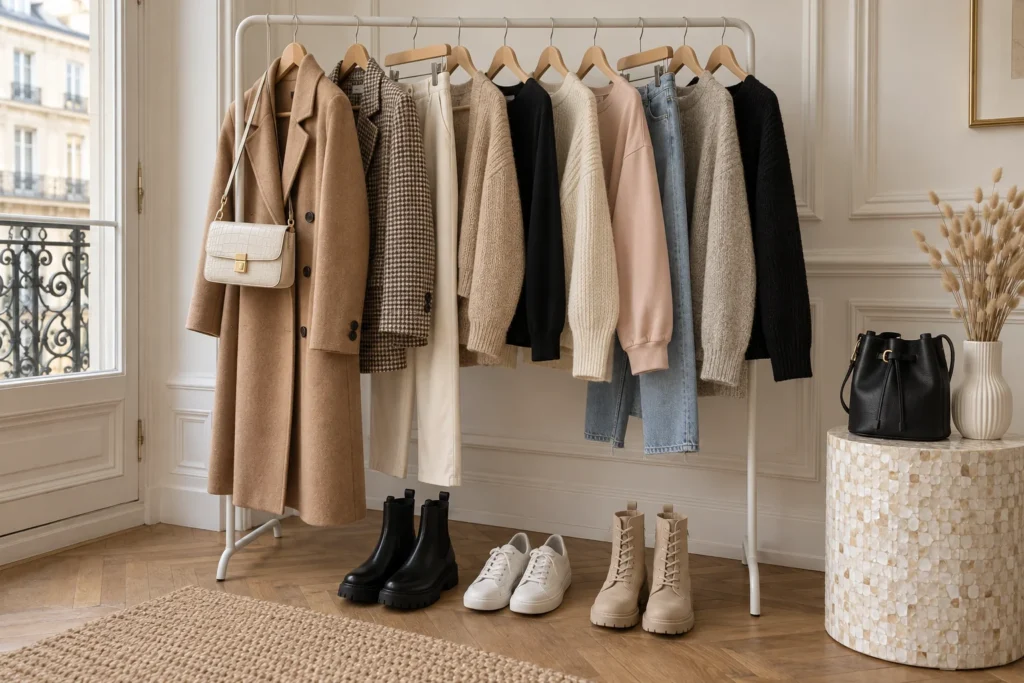
A closet can be full and still have nothing in it to wear. That is a matching problem, not a shortage: thirty tops, and each one goes with exactly one pair of trousers. Building a capsule wardrobe from the clothes you already own is how you fix it.
A capsule is a small group of clothes, around 25 to 30 pieces, where almost everything goes with almost everything else. This guide shows you which pieces to keep in rotation, which colors hold them together, and how to test each one before it earns a hanger.
You need the closet you have and one free afternoon. No shopping trip. Ahead: the short answer, the steps in order, and how to shift the capsule by season and by setting.
Pull the pieces you wore in the last two to three weeks. Narrow them to three neutrals and one accent color, then keep only what makes at least three outfits with the rest. Aim for 25 to 30 pieces, shoes and coats included, and box up everything else.
This is the example capsule used in this guide. Your colors may differ, and the method still holds.
Start With What You Already Wear
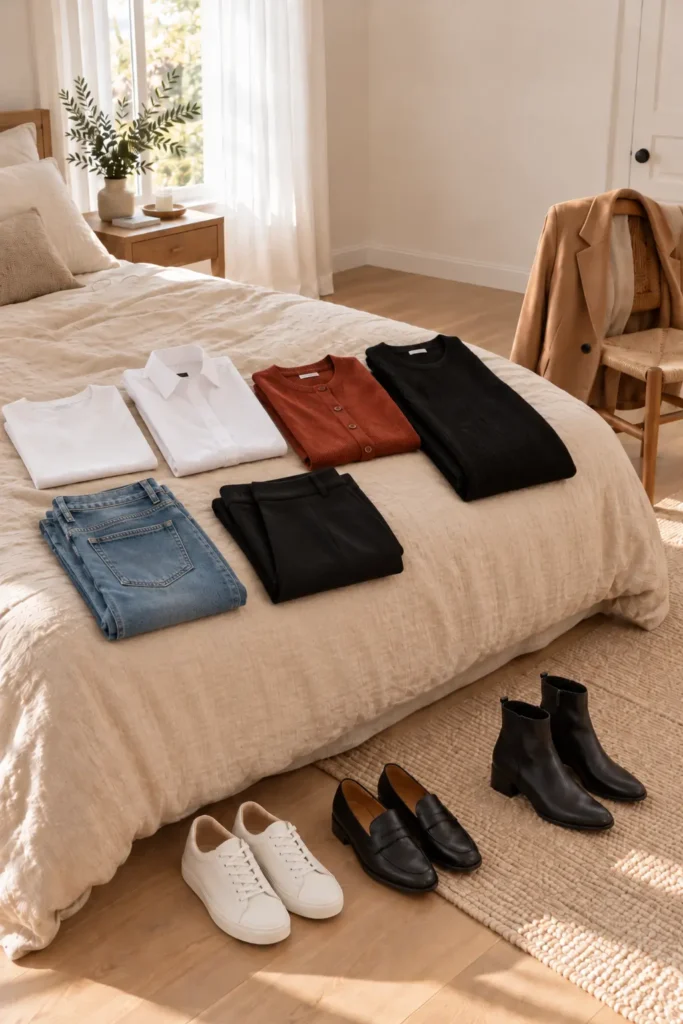
Pull out everything you wore in the last two to three weeks and lay it on the bed. That pile is your real capsule. It shows the life you have: the commute, the weather, the chair you sit in all day.
The pieces you skipped tell you something too. Maybe the fabric itches, the waistband digs, or the top needs a skirt you do not own. Deciding to be organized will not change that.
Add shoes, coats and bags to the pile. Leave out gym clothes, sleepwear and anything for one-off events.
If those weeks were unusual, say a holiday or a heat wave, use your last normal stretch instead.
Limit the Colors to Three Neutrals and One Accent
A small palette is what makes the mixing work. When every piece is one of four colors, any top goes with any bottom, and you stop needing one specific pair of trousers for one specific shirt.
Look at the pile on the bed and count the neutrals, meaning the quiet colors that go with nearly everything: black, white, cream, grey, navy, camel or tan. The three that show up most are your base. Blue denim counts too, so jeans get a free pass.
Then choose one accent, which is the brightest or warmest color you wear often: rust, olive, red or cobalt. Anything outside those four colors goes to one side for now.
The example capsule in this guide uses black, white and camel, with rust as the accent.
The example palette. Swap in your own three neutrals and one accent.
Outfit formula: rust fine-knit cardigan + white cotton crew-neck tee + black straight-leg trousers + white leather sneakers
Set a Number You Can Live With
There is no official number, so here is mine: 25 to 30 pieces, shoes and coats included. That is small enough to see at a glance and big enough to last two weeks between laundry days.
Keep about two tops for every bottom. Tops change how an outfit reads more than trousers do, and they go to the wash sooner.
A split that works:
- 9 or 10 tops, knits included
- 5 bottoms
- 2 dresses
- 4 layers and coats
- 5 pairs of shoes
Test Every Piece Three Ways
Three outfits is the pass mark. Hold each piece up against the pile and name three full outfits it makes, shoes included. If you stall at one, it is an outfit, not a capsule piece, and it goes to the side.
Take the white cotton button-down shirt. With jeans, use a half tuck, which means tucking in only the front few inches and letting the back hang loose. That shows the waistband and keeps the shirt from reading as a tunic.
Over the dress, leave it unbuttoned and roll the sleeves twice, to the elbow. Now it works as a light jacket. Buttoned under a blazer is the third way.
Shoes get the same test. A pair that works with one dress is a guest, not a resident.
Photograph each outfit that passes and save the shots to one album on your phone. On a rushed morning, you scroll and pick.
Outfit formula: white cotton button-down shirt + straight-leg medium-wash jeans + black leather loafers
Outfit formula: white cotton button-down shirt + black ribbed-knit midi dress + white leather sneakers
Box Up the Rest
Nothing leaves the house today. Fold whatever failed the test into a box or a suitcase, label it with the date, and put it out of sight.
This is what makes the edit honest. Cutting a piece is far less scary when you can get it back, so you stop keeping things out of guilt.
Check the box in one month. Anything you went looking for returns to the capsule. Anything you forgot about can be donated or sold.
Use Layers to Multiply the Outfits
If the capsule feels like the same three outfits by Wednesday, add a layer, not another top. The layer is the outermost piece, so it is the first thing anyone reads. Change it and the same tee and trousers look new.
The math is on your side: five bases and three layers make fifteen outfits.
Pick layers of different weights: a blazer for structure, a cardigan for soft days, a button-down shirt worn open in warm weather. Wear the blazer open and push the sleeves up once, to mid-forearm, so a tailored piece does not look stiff over a plain tee.
One limit: a layer has to fit over your thickest knit. A blazer that is tight over a sweater only counts for tees and shirts.
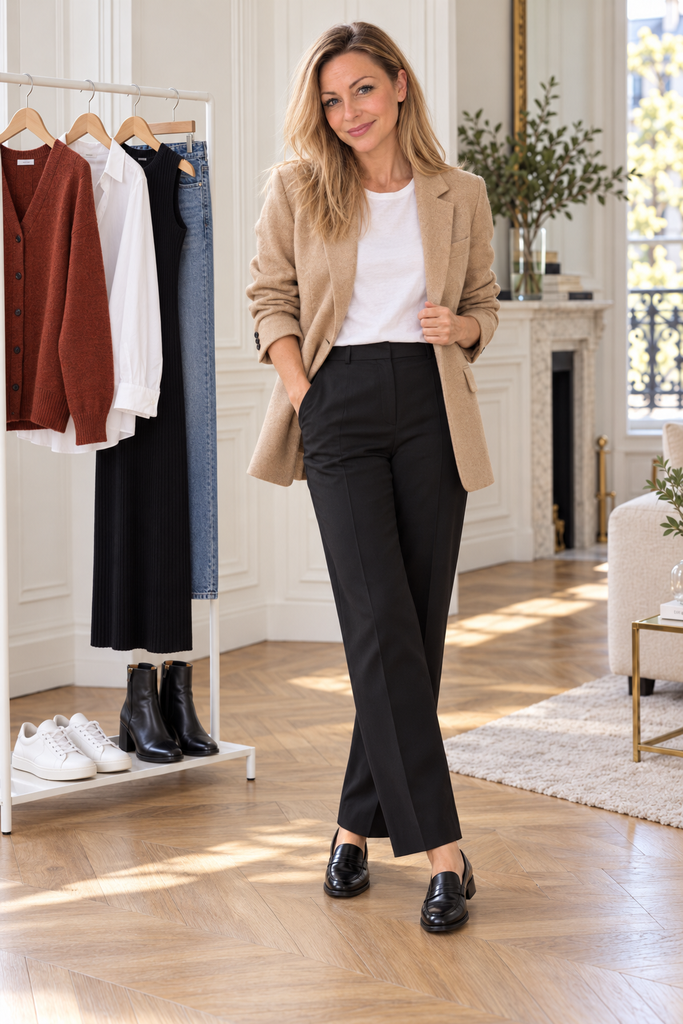
Outfit formula: camel wool blazer + white cotton crew-neck tee + black straight-leg trousers + black leather loafers
Name the Gaps Before You Buy Anything
Two weeks of wearing the capsule will show you what is missing better than any checklist. Keep a note on your phone and write down each time you reach for something that is not there.
Before you shop, check whether a piece you own can do a second job:
- A fine-knit cardigan, buttoned to the top, works as a sweater.
- A midi dress under a sweater works as a skirt.
- A button-down shirt worn open works as a summer jacket.
If the same gap shows up three times, buy that one piece, in one of your four colors. Stop at two purchases. More than that and you are building a second closet.
Outfit formula: rust fine-knit cardigan (buttoned and worn as a top) + straight-leg medium-wash jeans + black leather ankle boots
Swap a Third of It When the Season Changes
A capsule fails in July for one reason: it was built in January. Keep the core all year, meaning the jeans, the tee, the shirt and the blazer, and trade only the heavy fabrics and the shoes, about one piece in three.
When It Turns Warm
Wool goes into the box, and linen and light cotton come out. A wide-leg linen trouser lets air move, and flat leather sandals replace the boots. Linen creases within the hour, so let it.
When It Turns Cold
The coat matters most, because outdoors it is the only piece anyone sees. Keep it in a neutral and check that it buttons over your thickest sweater. Below about 50°F, a blazer stops working as your outer layer.
html
Stay inside your four colors when you swap, with lighter versions allowed: cream for white, tan for camel. A summer capsule in a new palette is a second wardrobe.
Outfit formula: white cotton crew-neck tee + cream linen wide-leg trousers + tan leather flat sandals
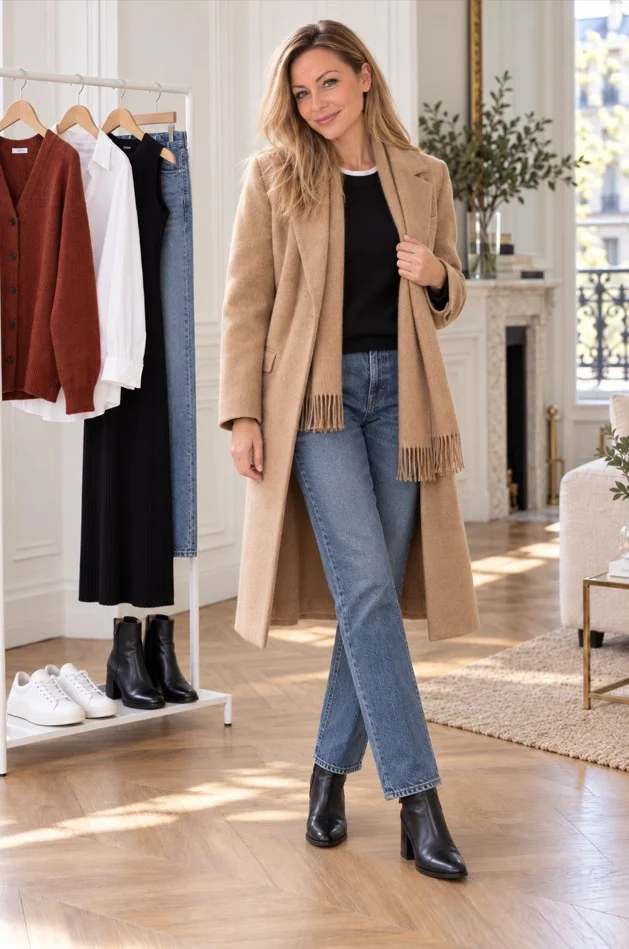
Outfit formula: camel wool coat + black crew-neck wool sweater + straight-leg medium-wash jeans + black leather ankle boots
Stretch It From the Office to the Weekend
You do not need two wardrobes. Keep the middle of the outfit and change the edges, meaning the layer on top and the shoes.
The black ribbed-knit midi dress shows how. With the camel wool blazer and the black leather loafers, it sits comfortably in most offices. On Saturday, trade the blazer for the rust fine-knit cardigan and the loafers for the white leather sneakers, and nothing about it says work.
Dress codes vary by office. In a formal one, stay with closed leather shoes and save the jeans for Friday, if they are allowed at all. When in doubt, read the handbook or look at what your manager wears on an ordinary Tuesday.
Outfit formula: camel wool blazer + black ribbed-knit midi dress + black leather loafers
FAQs
How many pieces should a capsule wardrobe have?
There is no official number. A range of 25 to 30 pieces, shoes and coats included, works for one season. Go smaller if your week is simple, and larger if you dress for both an office and weekends.
Do shoes and coats count in a capsule wardrobe?
In this guide, yes, because counting them keeps the total honest. Gym clothes, sleepwear, underwear and outfits for one-off events stay outside the count.
What colors are best for a capsule wardrobe?
The ones you already wear most. Choose the three neutrals that show up most often in your closet and add one accent. Black, white and camel is one example, and navy, grey and cream works the same way.
Can you build a capsule wardrobe without buying anything?
Yes. Every step before the gap check uses only what is in your closet. Wear the capsule for two weeks before you decide whether anything is missing.
What if most of my clothes are prints or bright colors?
Count a print by its main color, and check that it shares at least one color with your neutrals. Keep prints to one category, tops or bottoms, so two prints never have to meet in the same outfit.
How often should you update a capsule wardrobe?
At each change of season, swap about one piece in three. Between seasons, replace a piece only when the same gap has shown up three times.
The Takeaway
Building a capsule wardrobe from the clothes you already own rests on one test: if a piece makes three outfits with the rest, it stays.
Start with the white cotton button-down shirt, the straight-leg medium-wash jeans and the black leather loafers. You likely own all three, and the half tuck takes ten seconds.
Then give the capsule two weeks before you buy a thing.
Save this guide to your Pinterest board for the afternoon you clear the bed and begin.